


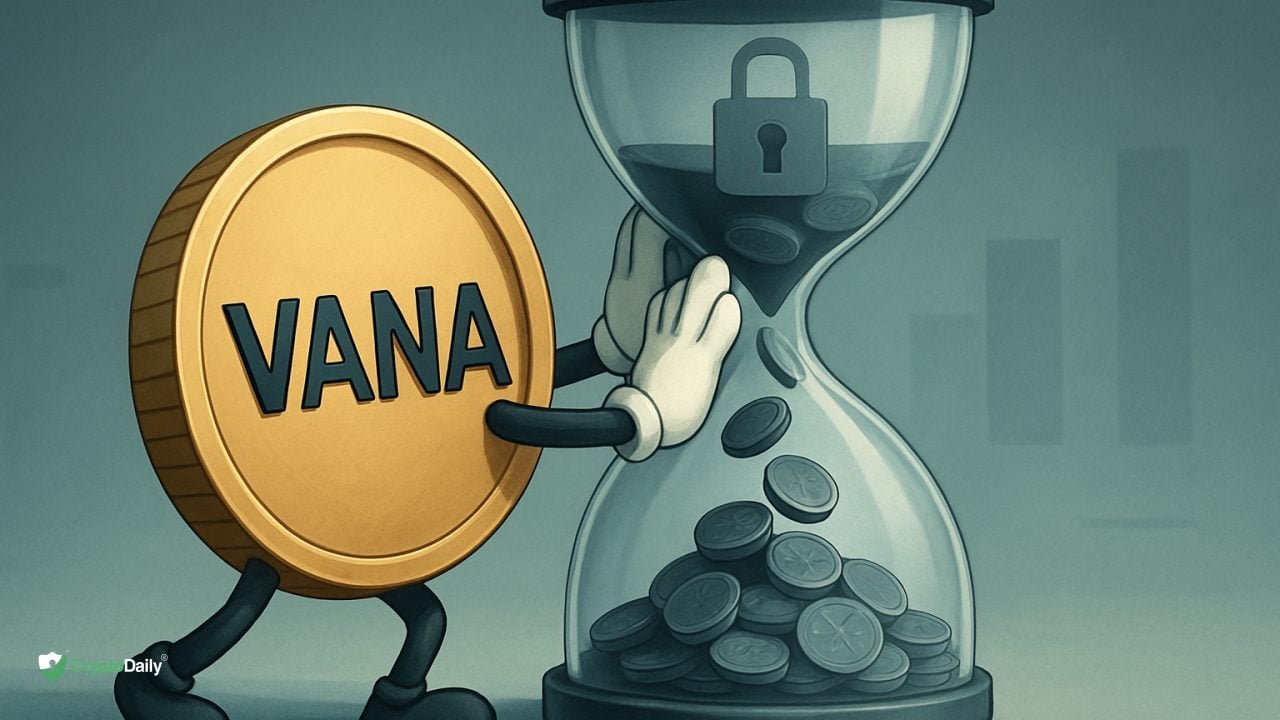
On June 16, a scheduled VANA unlock could drop a meaningful tranche of tokens into the market just as volumes thin out into mid-year. Depending on which tracker you trust, that influx is either large enough to bend near-term price discovery—or modest enough to be absorbed with planning.
DeFiLlama flags an unlock of roughly 9.11 million VANA, or 7.59% of total supply, with most flowing to “Community” and “Ecosystem” buckets (DeFiLlama (Vana unlocks page)). CoinMarketCap’s AI summary echoes the 9.11 million figure and pegs the tranche near $13.94 million, calling out a potential supply overhang relative to typical 24-hour trading (CoinMarketCap (CMC AI) — Vana price prediction / news).
Yet Tokenomics.com models the same date very differently, listing just 1.40 million VANA (about 1.2% of supply) and citing a negative 13-day move after the prior May 16 unlock—evidence that methodologies and measured impacts can diverge sharply (Tokenomics.com (VANA unlocks page)).
Why This Matters for Data Tokens Now
Editor's note: I watched multiple creator- and data-aligned tokens trade through unlock windows where headlines overstated or understated the actual flow. In gaming and NFT-adjacent names, the biggest price swings often came not on the date itself but when exchange deposits spiked 24–72 hours later. My takeaway: tracker discrepancies are common, and liquidity is the hinge. For VANA, I’m watching wallet-to-exchange movements and whether community and ecosystem tranches sit in program wallets or start trickling into spot. The difference between a smooth handoff and a scramble is usually execution, not narrative. — Maya Collins
Token unlocks are not new, but they can bite hardest when liquidity is thin, narratives are shifting, and model disagreements obscure expectations. Data-economy tokens—those tied to data contribution, access, or AI-aligned incentives—often rely on careful supply schedules to balance growth with market stability.
When new supply meets uneven demand, the order book—not the whitepaper—decides the short-term story.
As of a recent snapshot, DeFiLlama reports VANA’s circulating supply at about 30.8 million, a max supply of 120 million, and shows “Unlocked 50.99%,” placing the project roughly midway through its broader schedule (DeFiLlama (token metrics snapshot)). Against that backdrop, the June release takes on outsized importance: it could reset perceptions of VANA’s near-term float, or it could pass with only localized volatility if recipients stagger distribution.
Inside VANA: Token Flow and Data Incentives
VANA sits inside a growing class of tokens that aim to coordinate data contribution and access. Regardless of the exact mechanism, these systems must reconcile two forces: rewarding participation generously enough to bootstrap the network, while preventing excessive sell pressure that undermines long-run viability.
Data participation meets supply schedules
In the data-token category, emissions and unlocks play different roles. Emissions often incentivize ongoing behaviors (contribution, curation, or governance). Unlocks, by contrast, release previously allocated tokens—team, investors, ecosystem, or community—according to a vesting cadence. Markets sometimes conflate the two, but their impacts differ: unlocks change the potential float suddenly; emissions tend to drip more gradually.
Why the recipient mix matters
Who receives tokens matters more than the headline size. Allocations to strategic partners or ecosystem funds may circulate slowly via grants and programs, whereas investor or team tranches can behave differently depending on vesting, lockups, or trading agreements. Community allocations may distribute broadly, potentially increasing retail float if claim processes open quickly.
The June 16 Unlock by the Numbers
Trackers disagree on the size of this event. Comparing what’s on public dashboards helps frame the range of outcomes in play.
Source Reported amount Share of supply Est. USD value Notes DeFiLlama ~9.11M VANA ~7.59% — Breakdown shows ~6.18M Community, ~1.96M Ecosystem, ~488,914 Investors, ~480,255 Team. CMC AI ~9.11M VANA ~7.59% ~$13.94M Flags near-term supply overhang relative to typical volumes. Tokenomics.com ~1.40M VANA ~1.2% ~$1.6M Also notes a -13.5% move in 13 days after May 16 unlock (historical datapoint).
Why the split? Trackers often differ on what’s counted in a given “unlock” (on-chain claims vs. vesting eligibility), which allocations are bundled into a single event, and the reference for “total supply.” Some aggregate unlocks due on the same day; others isolate sub-tranches. That’s why triangulation—and watching the chain around the event—can be more reliable than any single dashboard.
Liquidity, Circulation, and Price Discovery
Volume vs. supply shock
CMC’s AI note frames the 9.11M VANA as a potential overhang vs typical 24-hour volumes (~$1.85M per DeFiLlama’s page at time of access), a dynamic that could amplify slippage if recipients head to market quickly (CoinMarketCap (CMC AI) — Vana price prediction / news; DeFiLlama). However, thin spot volume does not automatically imply a straight-line selloff: market makers can expand books, OTC desks can intermediate size, and recipients may ladder sales over days or weeks.
Circulating float and unlock cadence
With DeFiLlama showing roughly half of total tokens already unlocked, VANA is not in its earliest, tightest-float stage. That can cut both ways. On one hand, more unlocked supply can reduce the marginal impact of each new tranche. On the other, broader holder dispersion can increase the pathways for tokens to reach exchanges if sentiment turns.
Price discovery is path-dependent
Markets tend to price anticipated events in stages. Into the date, traders may short via perps or reduce spot exposure; as the unlock passes, covering flows or delayed claims can produce two-way volatility. If the tranche is closer to Tokenomics.com’s smaller figure, the market may have over-hedged; if closer to the DeFiLlama/CMC size, hedges might not fully offset realized flow. Either way, execution quality, liquidity routing, and timing will likely steer near-term price more than any single headline.
Allocation Recipients and Likely Behaviors
DeFiLlama’s breakdown points to Community and Ecosystem as the largest slices due on June 16. Investor and Team portions are smaller by comparison (DeFiLlama). That composition can influence how—and how fast—tokens circulate.
- Eligibility or vesting milestone: Tokens become claimable or move from restricted to transferable status.
- Claim and internal routing: Recipients claim to self-custody, multisig, or program vaults; some portion may remain idle for grants or incentives.
- Liquidity sourcing: If selling, recipients may test DEX liquidity, negotiate OTC, or stage CEX deposits to avoid impact.
- Market read-through: Traders watch deposit and transfer data to gauge realized float; narratives adapt (e.g., “absorbed well” vs “persistent overhang”).
- Follow-on effects: If price holds, teams often accelerate ecosystem disbursements; if it wobbles, some programs slow or stagger awards.
Community and ecosystem pathways
Community and ecosystem tranches don’t necessarily equate to immediate sell pressure. Grants, bounties, or staking programs can warehouse supply until milestones are met. That said, broader distribution opens more avenues for tokens to reach spot markets over time, especially if recipients lack contractual holding periods.
Reconciling Tracker Discrepancies and On-Chain Checks
Why models diverge
Unlock trackers can differ on: the definition of “unlocked” (eligibility vs. claimed), whether sub-allocations are aggregated into a single calendar item, how cliffs and linear vesting overlap, and which supply metric is used as the denominator. The VANA spread—9.11M vs 1.40M—illustrates how methodology choices create very different optics for the same date.
What to monitor in real time
Concrete, observable signals can cut through the noise:
- Large holder activity: Watch transfers from known vesting, team, or investor wallets to exchange-labeled addresses.
- CEX inflows: Sudden multi-million token deposits within hours of the event can foreshadow sell pressure.
- DEX liquidity depth: If pools thin while volatility rises, slippage risk increases even if absolute volume stays modest.
- Perps basis and funding: Persistent negative funding or widening basis into/after the date can signal hedging or directional bets.
Setting expectations
Given the tracker gap, scenario planning is prudent. If realized unlocks align with the larger estimate, markets may test lower liquidity bands before finding two-way flow. If the smaller figure proves correct, a relief reaction is plausible as shorts cover and programs resume disbursements.
Risks & What Could Go Wrong
- Mismatch between unlock size and liquidity: A larger-than-expected tranche hits thin books, exacerbating slippage.
- Coordinated selling: Multiple recipients choose to sell into the same session, overwhelming market makers.
- Model misreads: Traders over-rely on a single tracker, positioning poorly for the actual flow.
- Exchange bottlenecks: Deposits bunch up ahead of the event, creating a post-unlock supply bulge.
- Smart contract or operational delays: Claim, bridge, or listing timelines shift, altering the expected flow path.
- Regulatory headlines: Unrelated policy news can amplify volatility during a sensitive liquidity window.
Unlocks rarely break projects on their own—but they can magnify every other risk when liquidity is fragile.
For ongoing context and curated data on token schedules and market microstructure, readers often consult outlets like Crypto Daily alongside official dashboards and on-chain explorers. Cross-referencing reduces the chance of trading on a partial picture.
Frequently Asked Questions
Is the June 16 VANA unlock definitely 9.11 million tokens?
Not definitively. DeFiLlama and CMC reference ~9.11M (~7.59% of supply), while Tokenomics.com models ~1.40M (~1.2%). These differences stem from methodology and what each tracker counts as part of the event. Watching chain activity near the date is the best way to confirm realized flow.
How big is VANA’s circulating supply and what’s already unlocked?
DeFiLlama’s snapshot shows about 30.8M VANA circulating, a 120M max supply, and roughly 50.99% already unlocked at the time of access. Figures can change; always verify the latest data on the official tracker or reliable analytics pages.
Will price fall because of the unlock?
Unlocks can create near-term sell pressure, but outcomes vary based on liquidity, recipient behavior, and positioning into the event. CMC’s AI note frames the larger estimate as a potential overhang versus ~$1.85M typical 24h volume; still, OTC, staging, and market-making can moderate impact.
Who receives the June 16 allocation?
Per DeFiLlama’s breakdown, most of the slated tranche is tagged to Community and Ecosystem buckets, with smaller portions for Investors and the Team. That mix can disperse supply across grants, incentives, and broader holders, potentially smoothing—though not eliminating—sell pressure.
What explains the -13.5% post-unlock performance noted elsewhere?
Tokenomics.com’s page attributes a -13.5% move over 13 days after a May 16 unlock. That’s one historical datapoint, not a rule. Macro conditions, liquidity, hedging, and unlock composition can all differ month to month, so treat past stats cautiously.
How should holders prepare around an unlock without overreacting?
Focus on verifiable signals: track exchange inflows from known wallets, watch perps funding and basis, and check liquidity depth on major venues. Avoid trading off a single model; triangulate across trackers and official disclosures, and be mindful of execution and fees if adjusting positions.
Disclaimer: This article is provided for informational purposes only. It is not offered or intended to be used as legal, tax, investment, financial, or other advice.